
Hydraulic oil cleanliness: small particles, big consequences
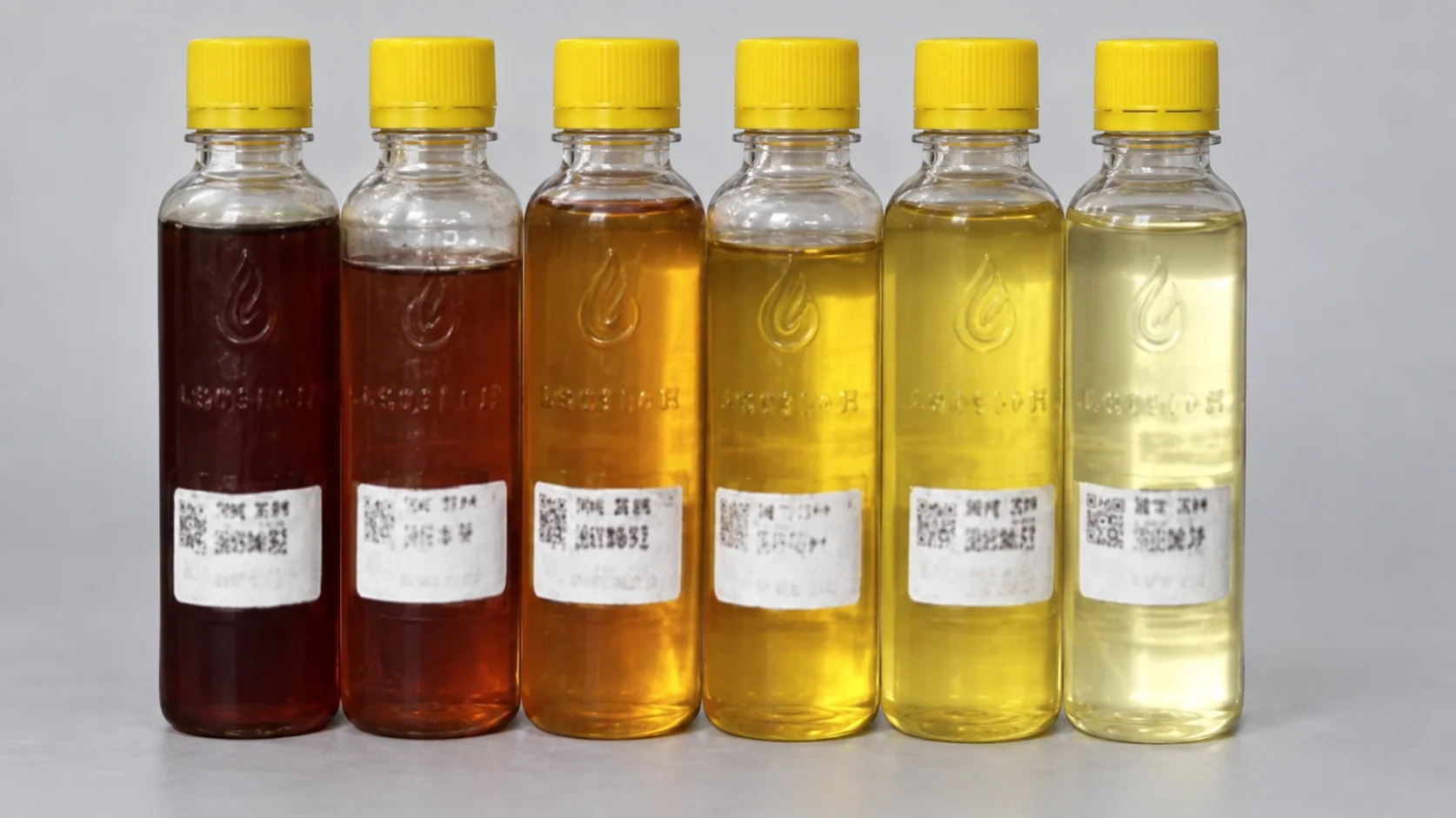
Comparison of the appearance of HLP-46 hydraulic oil samples.
These six hydraulic oil samples share the HLP-46 designation, yet their colours differ visibly. The photograph prompts an important question: what does appearance actually tell us about the oil? For hydraulic equipment, the answer must come from the specification and measured condition, including particle cleanliness—not from colour alone.
Cleaner oil: potential for a sevenfold service-life difference
Contamination control can have a major effect on equipment life. WearCheck’s Technical Bulletin 65 presents an indicative hydraulic-system life-extension table: improving from ISO 24/22/19 to 17/15/12 gives a potential factor of 7. The comparison is seven code steps in each channel.
Three steps, from 20/18/15 to 17/15/12, correspond to a factor of 2 in that table. These are model estimates, not an ISO 4406 requirement or a guaranteed pump lifespan. Results depend on the equipment, operating conditions and sustained cleanliness.
| Starting ISO code | Target ISO code | Code steps per channel | Potential life factor |
|---|---|---|---|
| 20/18/15 | 17/15/12 | 3 | 2× |
| 22/20/17 | 17/15/12 | 5 | 4× |
| 24/22/19 | 17/15/12 | 7 | 7× |
Same HLP-46 designation, different appearance
The HLP-46 designation does not assign an ISO 4406 cleanliness code. This comparison shows visible colour differences; it does not establish which sample contains fewer particles. No individual test reports for the six pictured samples are presented here, so no cleanliness ranking is assigned to them.
The HLP-68 batch example below is separate from these HLP-46 samples. Its numerical results come from the identified certificate, not from an assessment of this photograph.
Clean-looking oil is not a cleanliness test
Solid particles can enter during storage, filling or maintenance, and can also be generated by component wear. Circulating contamination may damage working surfaces and create further wear debris. Visual inspection alone cannot establish whether the oil meets the equipment’s particulate-cleanliness requirement.
Bosch Rexroth identifies fluid quality and cleanliness as important to system safety, efficiency and service life. The practical question is whether the fluid circulating through your equipment meets its specified target.
How to read ISO 4406
For automatic particle counting, ISO 4406 reports three cumulative particle-size thresholds per millilitre: ≥4, ≥6 and ≥14 µm(c). Each number is a concentration range. Lower codes indicate fewer particles; a one-code change corresponds to roughly a twofold shift in the range.
| Code | Particle size | Particles per mL |
|---|---|---|
| 18 | ≥4 µm(c) | More than 1,300 to 2,500 |
| 16 | ≥6 µm(c) | More than 320 to 640 |
| 13 | ≥14 µm(c) | More than 40 to 80 |
A real batch result: ISO 13/10/7
The HLP-68 certificate supplied by FEOTECH provides a concrete example. COA No. 7338 records ISO 4406 cleanliness of 13/10/7 for Gazpromneft Hydraulic HLP-68, batch 2415161701. Each code is below the corresponding maximum of 20/17/14 shown in the certificate.
The oil was produced on 18 September 2024, sampled on 19 September and certified on 21 September 2024. The packaging is listed as 205-litre drums. These are reported batch-analysis results, not a universal cleanliness guarantee for every HLP delivery or for oil already circulating in a machine.
| Parameter | Method shown in COA | Limit shown in COA | Batch result |
|---|---|---|---|
| Particle contamination code | ISO 4406 | Max. 20/17/14 | 13/10/7 |
| Viscosity at 40 °C | ASTM D445 | 61.20–74.80 mm²/s | 67.49 mm²/s |
| Viscosity index | ASTM D2270 | Min. 93 | 100 |
| Flash point, COC | ASTM D92 | Min. 220 °C (STO) | 243 °C |
| Water separation time | ASTM D1401 | Max. 30 min | 10 min |
The target comes from the equipment
The example above is not a universal acceptance limit. Use the current OEM requirements for the machine and its most sensitive components. A cleanliness code alone also says nothing about water content, viscosity or oil oxidation: those need separate checks.
Oil selection and contamination control work together. An appropriate hydraulic oil supports the application, while storage, transfer, filtration and maintenance determine how its condition is preserved in service.
A filter needs a verified result
Installing a filter does not prove that the target has been achieved. Its efficiency, position, operating conditions and bypass behaviour all matter. Select filtration with the equipment or filtration specialist, then verify the circulating oil rather than relying on a micron label alone.
Use representative samples and a consistent sampling point to track changes over time. Clean sampling equipment, suitable bottles and a documented procedure help prevent a misleading result. High-pressure sampling must follow the equipment’s safety procedure and be carried out by trained personnel.
From the drum to the machine in Indonesia
For Indonesian mining, construction, plantations and industrial plants, dust exposure and humid storage conditions are practical reasons to review how oil is handled. Keep containers closed, protect transfer connections and inspect reservoir breathers and cylinder-rod seals. Monitor water separately from particle cleanliness.
New oil should be checked against the required fill cleanliness, with suitable transfer filtration where needed. Ask three questions: what is the measured cleanliness in the drum, what is it after transfer, and what does the OEM require? A batch certificate or drum sample does not certify the machine after filling. Specify any special delivery-cleanliness requirement when ordering, alongside viscosity and product requirements.
Five actions for the maintenance team
- Record the OEM cleanliness target for each critical hydraulic system.
- Establish a baseline through representative particle counting and separate oil-condition checks.
- Control filling and top-ups with clean, closed transfer equipment and application-matched filtration.
- Inspect contamination entry points and monitor filter condition according to the service instructions.
- Trend the results, investigate departures from the target and confirm the outcome after corrective work.
Turn a laboratory result into a maintenance decision
FEOTECH’s previous field-quality-control article explains how sampling and laboratory results can provide a documented starting point. The next step is to connect that evidence to a machine-specific cleanliness target and a repeatable maintenance routine.
Send FEOTECH the equipment model, OEM oil requirements and your latest analysis. These provide a useful basis for discussing Gazpromneft hydraulic oil selection and the next verification steps. The aim is dependable operation supported by evidence and measurable maintenance targets.
A short Q&A with FEOTECH
Director’s perspectiveWhat should customers expect beyond the oil specification?
For FEOTECH, quality is more than a number in a product document. Customer confidence is built through an official supply route, traceable documentation and technical verification in the field. By coordinating sampling and independent testing, we help customers understand the condition of the product that will actually enter their equipment.
Customer technical supportWhat is the first practical step towards cleaner hydraulics?
Start with the equipment manufacturer’s cleanliness target and a representative oil sample. Compare the measured ISO 4406 code with that target, then review storage, transfer and filtration. After corrective work, sample again. The result for one delivery batch is a useful starting point; the oil circulating in the machine needs its own verification.
Make cleanliness part of your hydraulic oil specification
Discuss your equipment, operating conditions and oil-analysis results with the FEOTECH team.